Thursday, October 3, 2013

Herbs is the topic for our next meeting!

Join us for our next Organic Growers Meeting on Wednesday October 16 to hear Tina Richards, from the UCF Arboretum, present on growing and using herbs in Central Florida. As always, bring a item for our raffle, sign up to become a member, and join us for the after party at Ethos Vegan Kitchen.

Tuesday, October 1, 2013

Community Garden Bus Tour


Community Garden Bus Tour
sponsored by Our Whole Community
Saturday October 5th, 9am-1pm
Meet at Winter Park Community Center
Fee: $25 per person

Join us for a bus tour of 6 community gardens in the Central Florida area. The tour will start at 9am and end at 1pm at the new Winter Park Community Center where we will board the bus and visit 5 other community gardens including Winter Park Presbyterian Community Garden, St. Mary Magdalen Learning Garden, the Winter Park Urban Farm, and Our Whole Community Garden.  You will get to see several different models of community gardens and enjoy the beautiful scenery and then we will swing by the new East End Market to get lunch of some farm fresh menu items. To RSVP the Community Garden Tour email owc_ed@me.com.

Heres more details about the event:
$25 per person includes lunch at East End Market
The tour starts and ends at Winter Park Community Center
Tour 6 local gardens from 9am to 1pm
Special preview of East End Market
See the flyer on the homepage of http://ourwholecommunity.org scroll down a little.

Be sure to email owc_ed@me.com to save your space ASAP!


Wednesday, August 14, 2013

CFL Local Food Guide 2013

Lots of volunteers are working like crazy, behind the scenes, to bring you an awesome and updated CFL Local Food Guide. Be on the look out in mid-September (that's our target date).

Remember that the wonderful Tia Meer comes back from her travels and will be presenting at the Organic Grower's Meeting on the 3rd Wed in September. Looking forward to hearing all she has taken in.

Have a great rest of the week!!

Ann S.

Monday, December 10, 2012

Upcoming Permaculture Immersion

Simple Living Institute is hosting a Permaculture Immersion Program with Tia and Terry Meer at their Econ Farm this winter.


Join us January 3-6 at the Econ Farm in Orlando, Florida for a 4-day immersion into permaculture principals, food production, natural building, and community experience.
Cost: $350 per person. $50 discount for Simple Living Institute members.

Our Permaculture Immersion Program is structured using Permaculture’s concept of zones: zones of interaction and influence starting with your self and your home, and moving out into the garden, orchard, pasture, production forest, wild lands, and political and financial structures. Our teachers bring their experience to the table to help students best design and integrate the dynamic components of a sustainable lifestyle.

The Econ Farm is a permaculture homestead with the mission of being a living model of sustainability. As a well-established yet ever evolving 10-year-old site, The Econ Farm is an excellent working classroom for the development of hands-on skills.  You will learn about living off the grid, grow food in the garden, foraging for wild edibles, tending a fruit orchard, building alternative structures, solar power, community living, worm composting, humanure, whole foods and nutrition, cooking and more.

This all-inclusive 4-day immersion program includes workshops, healthy meals, and on-site camping. For more info contact Tia Meer, certified permaculturalist, at 321-217-8492 or email tiameer@gmail.com.

More at http://www.homegrowndelightsllc.com/classes.html


Wednesday, September 5, 2012

Volunteers needed!

Happy fall!

Simple Living Institute has an increasing number of requests from our community to promote sustainability, assist with new garden start-ups, and educational events.  Please consider helping us in our work by joining as a volunteer for our programs, helping to steer our organization as a board member or advisor, or helping with our monthly program the 3rd Wednesday of each month at Leu Gardens.  More info on our volunteer page at http://www.simplelivinginstitute.org/volunteer.html


Wednesday, July 18, 2012


Simple Living President, Tia Meer, just returned from teaching in Colorado.

Central Rocky Mountain Permaculture Institute was just blessed with a wonderful Introduction to Permaculture Workshop taught by Tia Meer from Orlando, Florida. The day started with a group discussion of the history and definition permaculture. Tia emphasized how permaculture is a design process and as permaculture designers it is up to us to put all the elements in the right place to maximize the functions and relationships of each element. We talked about permaculture principals by Bill Mollison and David Holmgren and the ethics of permaculture, which are earth care, people care, and the concept of fair share. Next, Tia presented on zone and sector planning and stressed how important it is to put the high maintenance areas such a vegetable gardens close to the house and also the importance of having a zone 5 where we can learn from nature and be inspired.

In the afternoon we learned about plant guilds and the benefits of perennial polycultures, which is basically companion planting of plants that live for a long time. Tia created a very useful plant list that highlighted the functions of the plants found in this region of Colorado showing if they were edible, nitrogen fixers, or dynamic accumulators (plants that bring up nutrients from deep in the soil).

The day ended with a chop and drop activity where we helped the cherry, apple, and plum fruit trees grow by mulching with fresh trimmings from nitrogen fixers, carbonaceous materials, and dynamic accumulators of Siberian pea shrub, cattail harvested from the pond and comfrey respectively. We had a great day, an awesome lunch, and everyone learned a lot. The feedback from the students was great. CRMPI intern Sarah Morehouse said “Tia’s teaching technique is very inviting and informative. “
Comment

You need to be a member of CRMPI Blog to add comments!

Comment by CRMPI yesterday

Tuesday, May 8, 2012

Simple Living Update with Tia Meer

Natalie Costa recently interviewed Simple Living Institute's president, Tia Meer.  Check out her Backpackers Journal blog at http://www.backpackjourna.com/human-interest-profiles/simple-living-update-with-tia-meer/ to learn more.  The interview covers what Simple Living is going, other community organizations to get involved with, and a little Simple Living philosophy.

Thursday, March 22, 2012

Central Florida Fair

With Spring in full swing around Central Florida I was truly looking forward to the Central Florida Fair.
It was an unusually rainy day for us (of late), but we headed out on the last day of the fair to see what this year's festivities brought.

Okay I think I've officially become a Floridian, as the rain made it cold!
Especially inside at the table, where we sat and greeted folks who came in from the yukky weather to take a look around. We were positioned at the far end of the hall. The weather made it a light-traffic day, but we spent our timing talking with a number of interesting people. One was a women who was a master gardener and enthusiastic about Simple Living's display, especially the food guide and our classes for kids. Another gentleman came to get information about the Organic Grower's meetings, as he and his wife have been inspired by successfully growing tomatoes, to find others who they can talk with about growing Florida friendly plants.

The best part for me, was after more than a year of growing plants here in CFL, I was able to share my personal experience's, not just those of my fellow Simple Liver's. I made lists for a number of people of my favorite heirloom plants that are/were flourishing in my growing space. It was a very relaxed day of talking butterflies, plants and recommending places to get seeds/ plants that work well here.

Thank you for those who set up the display it was great; from the irrigation, the sweet potato, the butterfly sheets, the Central Florida Food Guide and the kids classes board - there was definitely something for everyone to be interested in.

I love being inside this hall with the stamp collectors, wood turners, stone polishers and various other crafters. It reminds me that the time for all these important arts is still NOW. That the knowledge is alive and being shared with those willing to take a moment out of their busy world to slow down and enjoy a quiet rain free room with many passionate folks to explain their wares.

If you missed this year's fair, mark 2013 for early March and head out. It's a great way to spend an afternoon enjoying Florida and all the variety we have to offer.  Make certain to stop by the Simple Living table and take a look.

We hope to see you there!
Until next time.
Ann S

Monday, March 19, 2012

Thank you Simple Living Volunteers!

I would like to thank all the people who contribute to the existence of Simple Living Institute! To all of our volunteers, members, educational partners, and people who attend our events, THANK YOU! We recently celebrated and showed our appreciation of our volunteers at our Volunteer Appreciation Dinner hosted by Ethos Vegan Kitchen. Visit our photo gallery on our website at www.simplelivinginstitute.org to view the photos of the event. We are always accepting new volunteers too! Please email us at volunteer@simplelivinginstitute.org and learn more about our volunteer opportunities. We are currently in need of volunteers to help with administration, garden start-ups, outreach events, and our Organic Growers Meeting.

Tuesday, February 28, 2012

Study: Only 10 percent of big ocean fish remain (CNN)

You may have noticed some recent press drawing attention to the quick decline of big ocean fish species.  Sadly, the human appetite for these fish is bringing some of them to the edge of extinction.  As with any ecosystem, the balance is very delicate, and mysterious.  It is not yet clear what the loss of these big fish will mean to our oceans.
View this old article (2003) from CNN to learn more: More at CNN


What can you do?  As a consumer, it is best to avoid eating fish that are in peril.  Download a regional seafood guide (care of the Monterrey Bay Aquarium) and have it handy when you're picking out a seafood meal.
Get the Guide!

Sunday, February 5, 2012

Seeds, seeds, seeds

I don't know about you but I'm SO EXCITED for February to be upon us. Living here in Central Florida, it still amazes me how much time I can spend outside. This month symbolizes that re-connection of really being able to be in the dirt for me. Of course, it all starts with our wonderful seeds.

Did you know that Simple Living Institute hosts a Seed Exchange this month? It is part of their ongoing effort to connect people to growing with sustainable, local, non GMO varieties that truly work in our region. The August Exchange was my first experience and wow did I have a great time helping behind the scenes. This event myself and DS will be helping at one of the tables. We are looking forward to it.   

Mark your calendars - you won't want to miss it!!! 
Wed. Feb 15th from 6:45 - 9:00 at Leu Gardens Camille Room

Simple Living has done this event for a number of years and gotten fairly efficient. Here is a "how to" so you can get the most from the experience......
* Arrive EARLY - this is a very popular event
* Please cap yourself at 30 packets (so everyone has a turn)
* This is an exchange. Bring 10 diff types, get 10 new types
* Pre-sort seeds - if they aren't you will have to do so there
* Info on each packet should read:
   1. Seed Type  For example: Green Beans- Bush, Tendergreen
   2. Number of Days until Harvest  60d/ bears 3 wks
   3. Planting Guideline – Direct, transplant, 6”apart, ½” deep, Sep-Nov.
   4. Seed Source  My Garden Green Beans or Parks Seed Catalog
So it might look like this on the packet:   
My garden Greenbeans / Bush, Tendergreen / 60d bears 3wks / direct, transplant 6" apart, 1/2" deep from Sept-Nov
* Exchange tickets can be purchased for $0.25 (4 for $1)
* Please provide feedbackIf you have gotten seeds from the exchange previously let us know how they did so we can ensure future seeds purchased for the exchange are even more successful. 
* Any unredeemed tickets can be refunded at the end. 

The event will have tables set up in these categories:
o Cucubits: Cucumbers, squash, pumpkins, melons, etc.
o Flowers, Fruits &  Trees: Papaya,  nasturium,  sunflowers,  eucalyptus, hibiscus, citrus
o Greens: Lettuce, brassicas, spinach, chard, collards...(turnips & beets are also roots)
o Herbs: Basil, chamomile, lemon grass, mint, and oregano, etc.
o Legumes: Beans, peas, pigeon peas, peanuts, etc.
o Roots: Beets, carrots, onions, radish, turnips, chives, etc.
o Solanaceae: Tomato, pepper, eggplants, tomatillo, etc.
o Other: corn, grains, okra, unique seeds like wild Florida cotton

So that's the exchange in a nutshell. It's so much fun and a great way to connect with like minded folks. We look forward to seeing you there! 
Happy gardening.
Ann S.

Wednesday, January 4, 2012

New videos of Simple Living Institute

Over the holiday break I had some free time to google search on the internet and I found some video footage of our Organic Growers Meeting and our newly released Local Food Guide on YouTube. I posted them on our media page on the website. Check em out at http://www.simplelivinginstitute.org/media.html

Sunday, October 23, 2011

Keeping GMO's off your Plate

By: Dr. Samadhi Keever
To contact Samadhi visit: www.injoyhealthcare.com

Genetically Modified Organisms were first introduced into our food supply in the 1980’s. They appeared without consumers knowing what was happening…until recently. Currently there is a GMO scare circulating through the social media. GMO crops look, smell, and taste like normal food, so how can we protect ourselves?
A GMO By Many Names Is The Same:
GMOs are referred to by several acronyms and proper names: Genetically Modified Organism, GMO, Genetically Modified, GM, Transgenic, Transgene, and Bt (which is the name for a bacterium used during the genetic modification process). Plant seeds are often referred to as Bt or Round Up Ready, implying they are ‘safe’ to spray with the glyphosate herbicide called Round Up, which is manufactured by Monsanto.
There are hundreds of crops being experimented with using bacteria, viruses, antibiotics, plant, animal, and insect DNA and this is cause for alarm. Although there is much experimentation, not all of these science projects make it to the grocery shelves. Some that have made it to the shelves have been rejected. Years ago, the DNA from cold water fish was added to a tomato seed, producing a GM tomato plant that was cold-hearty. This failed in the market place because consumers didn’t like the flavor. Crossing a fish gene with a vegetable gene is suspect and the side-effects to human health are yet to be determined.
Current List of GM Foods:
The following Genetically Modified foods are being sold in our stores right now: corn, wheat, soy, canola, Hawaiian papaya, alfalfa, zucchini, and yellow crookneck squash. Buy organic! USDA Certified Organic guidelines (currently) do not allow GM foods to carry an organic label.
Sources of GM Foods in the Food Supply:
GM wheat, corn, and soy show up in most boxed or packaged ‘foods’ and this is what the scary statistics in the social media are pointing to. Wheat, corn, and soy are farmed in massive quantities. These crops are used by manufacturers to make things such as ketchup, vitamin supplements, eco-friendly, non-plastic corn utensils, veggie burgers and other vegan and vegetarian meat-substitutes, tofu, soy milk, corn syrup, energy bars, protein powders, cereals, breads, candies, snack ‘foods’, pastries, food additives, rennet, artificial sweeteners, enzymes, and the list goes on.
GM crops are used as feed for livestock and poultry, which translates into meat, eggs, and dairy containing GM constituents. Buy meat, poultry, and dairy from local farmers who you can talk with about what they are feeding their animals. Farm raised fish are also fed genetically modified grains. Get your fish labeled wild-caught and locally sourced if available.
Other sources of GM contamination are dairy products from cows injected with rbGH. This is a Genetically Modified hormone (created by Monsanto) to increase the production of milk. Organic milk does not contain rbGH.
Grass Roots…Taking Action, Get Involved!
There are many resources that we can utilize to stay aware and educated of what is actually in the food supply here in the United States. It is important to clarify ‘in the United States” because GM seeds and food are being exported to other countries.
There is now a voluntary Non-GMO seal that companies can receive to distinguish their product from GMO competitors. If you see a product labeled with a Non-GMO seal, support this company by purchasing their product. Getting this seal is a costly process that is not mandatory. Many of these companies are small, independent businesses, which have elected to put their product through this expensive, voluntary testing regime to earn this seal.
Our shopping dollars influence what is being sold in the stores. GMOs are not allowed in USDA Certified Organic Foods. Buy ORGANIC! There is a Non-GMO Shopping Guide which lists companies that guarantee there are no GM ingredients in their food. Download the Non-GMO Shopping Guide online for free (see Resources).
The Institute for Responsible Technology is working diligently with groups such as The Organic Consumers Association and The Center for Food Safety. These organizations are the leaders taking large corporations such as Monsanto to court in a monumental effort to keep GM crops from entering into our food supply. They are working to create a mandatory label on foods that have GM ingredients. Support these organizations and sign up for their email newsletters. The Organic Consumers Association fuels the Millions Against Monsanto Campaign; join this effort on their website (see Resources).
Shopping for locally produced items is beneficial for our local economy and gives us a chance to meet the folks involved in growing, raising, packaging, and selling the food we eat. Farmer’s Markets and local food stores such as the Florida Homegrown Co-op in Orlando and Essential Health in Altamonte Springs provide locally sourced foods.
Make your own grass roots movement…grow your own! GM seeds do not make it into the home garden. Having your own garden is a wonderful way to keep your green thumb on the pulse of your own food supply.
Resources:
Institute for Responsible Technology (http://www.ResponsibleTechnology.org)
Center for Food Safety (http://www.CenterForFoodSafety.org)
Non-GMO shopping guide (free download) ( http://www.NonGmoShoppingGuide.com)
Organic Consumers Association (http://www.OrganicConsumers.org)
Millions Against Monsanto Campaign (http://www.OrganicConsumers.org/monsanto/index.cfm)
Uncertain Peril (book) by Claire Hope Cummings
The Future of Food (movie)
Food Inc. (movie)
Florida Homegrown Co-op (http://www.homegrowncoop.org)
Essential Health Market (http://www.hooversmarket.com)
Community Supported Agriculture
Local farms and local farmers
Farmers Markets
Your own garden

Sunday, October 2, 2011

The Winter Park Urban farm experiment


The Winter Park Urban Farm is an urban farming experiment in the heart of Winter Park. We will be meeting once a week throughout this Fall to work the farm and learn about urban agriculture. The mission is to take a vacant residential lot in Winter Park and convert its fallow land into a productive harvest garden.
With 11 weeks to work with we are looking to see just how much produce we can grow and bring to market at this year’s Winter Park Harvest Festival. Along the way we will beoffering volunteers and our “ag-curious” neighbors free lessons on the in’s and out’s of organic agriculture.
Join Tia Meer and John Rife for the next farm days at the Winter Park Urban Farm scheduled for Tuesday October 4th from 4-6pm and Thursday October 13th from 10am till noon . We will be planting more biointensive beds of vegetables and checking on our baby bean, broccoli, cabbage, collard, cucumber, carrots, and pea plants. Bring your favorite shovel! More info at http://winterparkharvestfestival.com/market/urban-farming-experiment/466

Friday, September 23, 2011

Making Connections: Anarchy & Permanent Culture

Permaculture is about allowing natural systems to exist. Its about helping them to become more diverse and therefore, strong, healthy, and “more productive”. Modern thinking and philosophy involves that you apply force to a system in order to bend it to your will, that we become "masters over nature". The conventional approach is that a system will either perform as you instruct it, or be destroyed and replaced. And I do mean DESTROYED. Current landscaping techniques vitiate healthy natural systems so that they can install a particular order that is convenient to manipulate and control, but that devastate millions of years of perfectly balanced ecosystems. This can sometimes be repaired, but the overall pollution may make some areas toxic breeding grounds, incapable of sustaining life.

The good news is that natural, organic systems, although complex, can be “guided” along with ever diminishing need for human intervention by the use of bio-mimicry. Of course the answer is not to destroy the natural systems in the first place. Our best option would be to allow the system to interact, while introducing beneficial elements that offset our use of an area.

These natural systems, I believe, are the essence of anarchism. Anyone who has observed nature can tell you is that when you change the natural balance of a system, the end results are almost always a disaster. Anarchism is about belonging to natural systems. Those that evolve from free interaction between autonomous actors, both in nature and in human social structures. And as with permaculture, it is necessary that each actor be allowed to evolve and grow. As the anarchist-ecologist Murray Bookchin put it,

"The notion that man must dominate nature emerges directly from the domination of man by man...But it was not until organic community relation...dissolved into market relationships that the planet itself was reduced to a resource for exploitation."

Unnatural systems force actors to perform in a rigid manner, or risk destruction. Natural systems allow actors to unfold as a part of their environment, providing fertile ground that promotes growth, diversity, and resilience, not destruction.

We, as living organisms, evolve along with our environment. The mutilation of these natural systems destroys not only that system or resource, but destroys life on a cellular level that even human stewardship cannot redeem. Fortunately, we don’t have to rely on artificial science to fix the problems humans create in their environment, including their social structures. Natural systems already know how to deal with those problems. If only we would let nature reign.

Wednesday, August 10, 2011

Simple Living Organic Grower's Meeting – the Seed Exchange


Get your seeds ready and arrive early at 6:45pm on August 17, 2011 at Leu Gardens for Simple Living Institute's August Seed Exchange. For details, check out:


See you there!

shayla@simplelivinginstitute.org


Tuesday, July 26, 2011

Orlando Permaculture Design Course
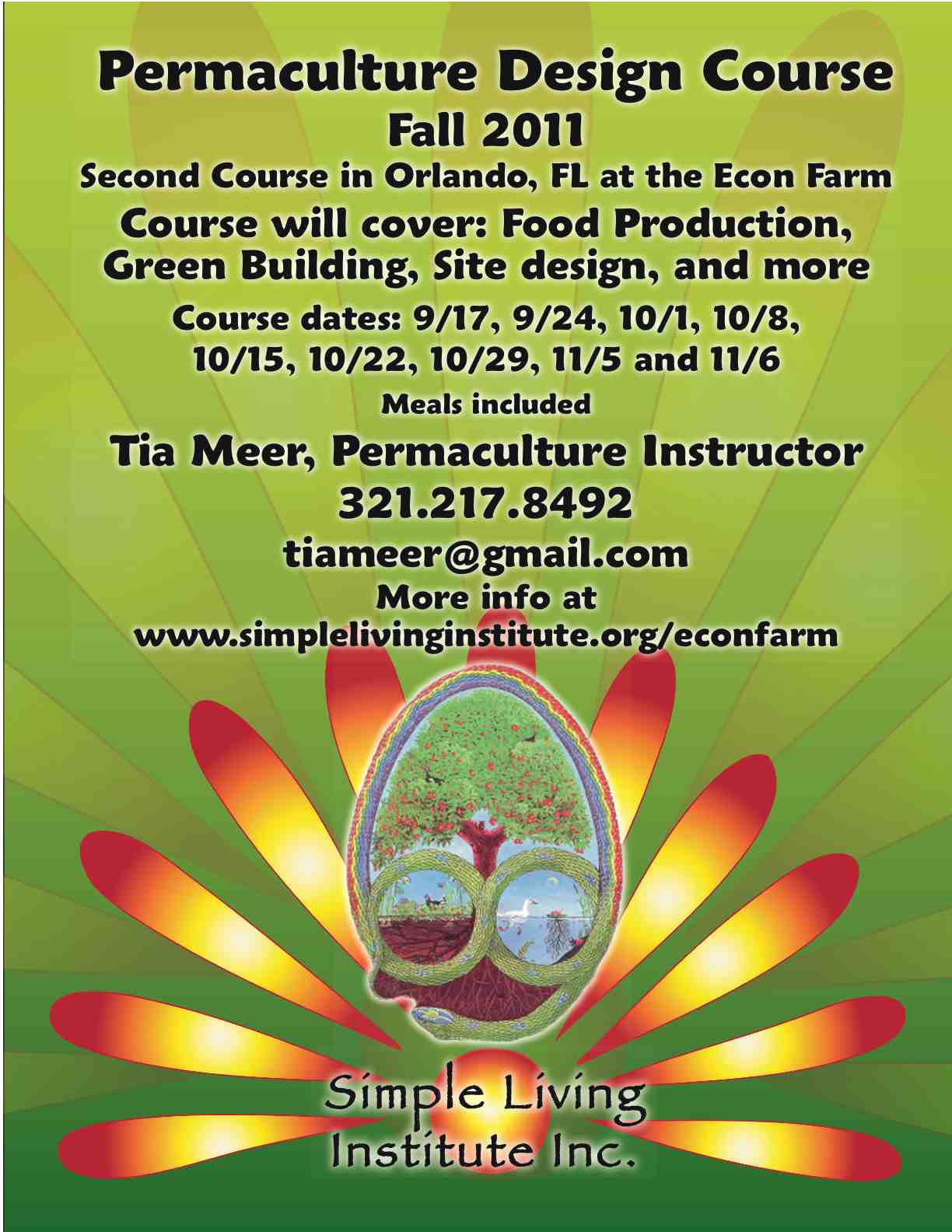

We are pleased to offer the second Permaculture Design Course at the Econ Farm in Orlando, FL. This will be a weekend-format 72-hour course that will give you an in-depth understanding of Permaculture design concepts and applications in the Central Florida region. Participants that attend all sessions of this class and complete the final design project will receive a certificate in Permaculture Design.

Permaculture is a design for sustainable living. Permaculture's foundation of principles and design concepts are universal and can be suited for any region or location. The principles of permaculture can help us reduce society's overuse of industrially produced resources which are destroying the Earth's ecosystems and help us transition to self-reliant homesteads.

Course Dates:
September 17 and 24
October 1, 8, 15, 22, and 29
November 5 and 6

Fee: $1,150 members / $1,200 non-members
Advanced Registration Required! Class size limited to 12 people.
Registration ends Sept 7th, 2011
Contact us to request the course overview
Tia Meer at (321) 217-8492
tiameer@gmail.com
www.simplelivinginstitute.​org/econfarm.html

Thursday, July 21, 2011

Mead Garden Community Garden


Join us for a volunteer work day at Mead Garden's Community Garden in Winter Park. The community garden is also looking to fill some vacant plots. Meet at the garden site at 8:45am and bring hat, sunscreen, water, and tools to trim brush and trees. More info and map to the garden site at http://winterparkharvestfestival.com/gardening/community-garden-day-mead-gardens-this-saturday/417

Wednesday, July 13, 2011

Our Local Food Guide


The Central Florida Local Food Guide will be the first comprehensive listing of farms, community gardens, and farmers markets in the region. It has been our largest and most exciting project of the year. Join Simple Living Institute and learn about the Guide, soon to be released. Andrew Landis, director of the project, will be presenting and we will be recognizing our sponsors, Our Vital Earth, Winter Park Harvest Festival, Simply Well, First Unitarian Church, and Winter Park Health Foundation. Our Guide is scheduled for release late this summer. More info on our website at www.simplelivinginstitute.org/local-food.html

Thursday, June 9, 2011

Free Electronic Waste Recycling Saturday, June 11th, 2011

Keep Orlando Beautiful is holding an Electronic Waste Collection on Saturday, June 11th, from 9am to 1pm, at Orlando Festival Park near the intersection of Robinson & Bumby.

They will be collecting the following items for recycling:
• Computer Monitors
• Televisions (limit one per household)
• Telephones
• Cell Phones
• Telephone Systems
• Fax Machines
• Central Office Equipment
• Rechargeable Batteries
• Electronic Circuit Boards and Components
• Stereo Equipment
• Games
• PDA's

For complete details, please see the Keep Orlando Beautiful pdf flyer:
Electronic Waste Collection (.pdf)

This is a free service and we at Simple Living encourage you to take advantage of the opportunity!