Tuesday, July 26, 2011

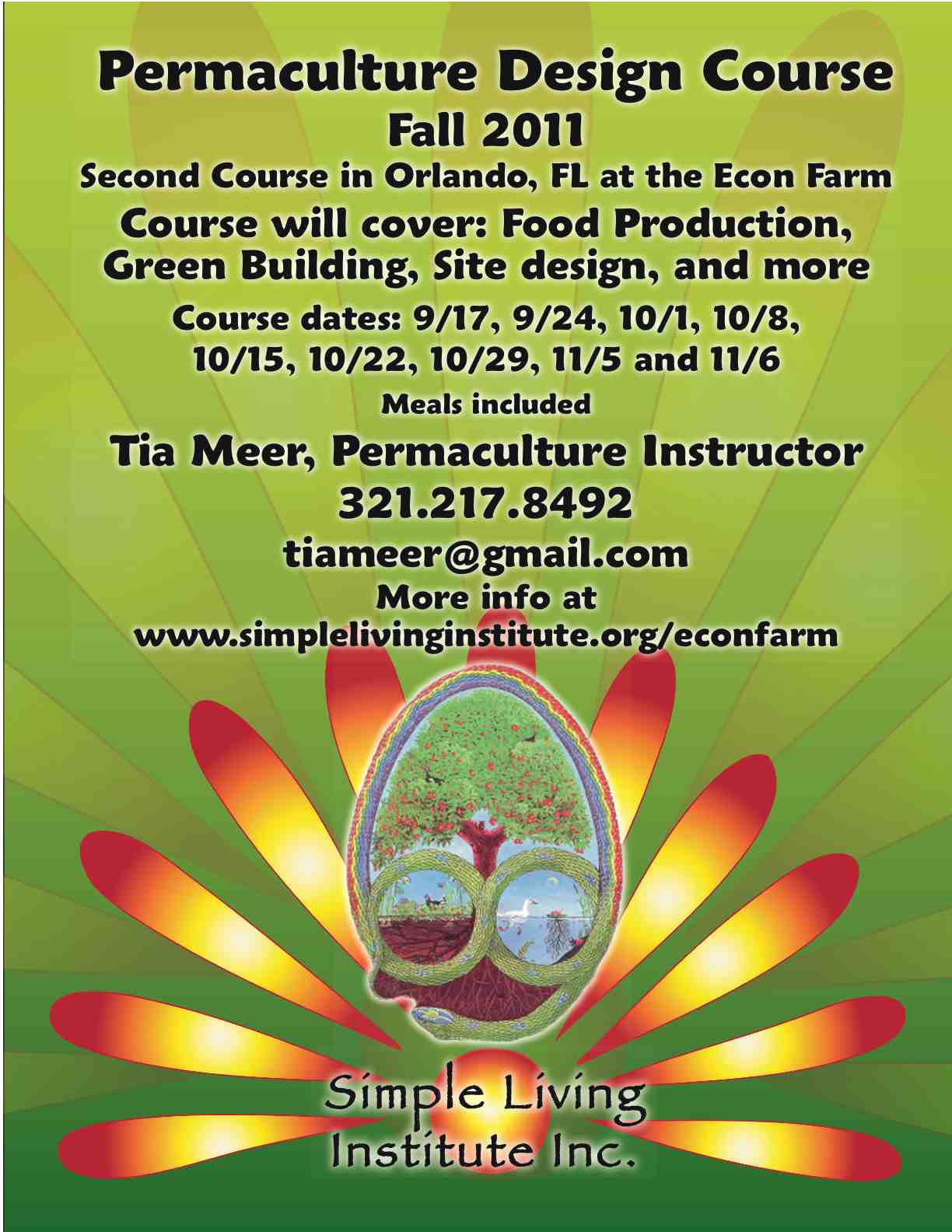
Orlando Permaculture Design Course


We are pleased to offer the second Permaculture Design Course at the Econ Farm in Orlando, FL. This will be a weekend-format 72-hour course that will give you an in-depth understanding of Permaculture design concepts and applications in the Central Florida region. Participants that attend all sessions of this class and complete the final design project will receive a certificate in Permaculture Design.

Permaculture is a design for sustainable living. Permaculture's foundation of principles and design concepts are universal and can be suited for any region or location. The principles of permaculture can help us reduce society's overuse of industrially produced resources which are destroying the Earth's ecosystems and help us transition to self-reliant homesteads.

Course Dates:
September 17 and 24
October 1, 8, 15, 22, and 29
November 5 and 6

Fee: $1,150 members / $1,200 non-members
Advanced Registration Required! Class size limited to 12 people.
Registration ends Sept 7th, 2011
Contact us to request the course overview
Tia Meer at (321) 217-8492
tiameer@gmail.com
www.simplelivinginstitute.​org/econfarm.html

Thursday, July 21, 2011

Mead Garden Community Garden


Join us for a volunteer work day at Mead Garden's Community Garden in Winter Park. The community garden is also looking to fill some vacant plots. Meet at the garden site at 8:45am and bring hat, sunscreen, water, and tools to trim brush and trees. More info and map to the garden site at http://winterparkharvestfestival.com/gardening/community-garden-day-mead-gardens-this-saturday/417

Wednesday, July 13, 2011

Our Local Food Guide


The Central Florida Local Food Guide will be the first comprehensive listing of farms, community gardens, and farmers markets in the region. It has been our largest and most exciting project of the year. Join Simple Living Institute and learn about the Guide, soon to be released. Andrew Landis, director of the project, will be presenting and we will be recognizing our sponsors, Our Vital Earth, Winter Park Harvest Festival, Simply Well, First Unitarian Church, and Winter Park Health Foundation. Our Guide is scheduled for release late this summer. More info on our website at www.simplelivinginstitute.org/local-food.html

Thursday, June 9, 2011

Free Electronic Waste Recycling Saturday, June 11th, 2011

Keep Orlando Beautiful is holding an Electronic Waste Collection on Saturday, June 11th, from 9am to 1pm, at Orlando Festival Park near the intersection of Robinson & Bumby.

They will be collecting the following items for recycling:
• Computer Monitors
• Televisions (limit one per household)
• Telephones
• Cell Phones
• Telephone Systems
• Fax Machines
• Central Office Equipment
• Rechargeable Batteries
• Electronic Circuit Boards and Components
• Stereo Equipment
• Games
• PDA's

For complete details, please see the Keep Orlando Beautiful pdf flyer:
Electronic Waste Collection (.pdf)

This is a free service and we at Simple Living encourage you to take advantage of the opportunity!

Tuesday, June 7, 2011

How to Remove Grass for a Garden


I would say the best way to remove grass and prepare for planting is to smother it with cardboard and then put the mulch on top of the cardboard. The cardboard will kill the grass and then decompose and add to the soil. Heres what to do:

1. Mow or weed whack the area
2. Wet the ground or cardboard (optional) maybe we can get a big bucket and soak it in the bucket for a few before laying it down
3. Lay the cardboard down starting at the corner of the garden where the first plots will go, be sure to overlap sides so no grass can peek through
4. Put a 6" layer of mulch on top of the cardboard. Cover all the cardboard with mulch.

This is the technique we will use to prepare the grounds at the new Coytown Community Garden. Join us for our next workday on June 25th. More info at www.coytowngarden.com

Friday, May 13, 2011

News from the Market Gardening committee: How many ways can a local produce grower market their crops to the members of their local community?

U-Pick saves the the grower the harvesting, washing, packing, labeling, transport, sales commission fees, invoicing, and possible inspection costs (organic labeling provides customers the trust when direct inspection {Caveat Emptor} isn't available). The customer base is limited by driving distances factored by crop selection. But once a local customer is hooked up with a local grower, the relationship is similar to your own backyard garden.

Farmer's Markets requires the grower to harvest, pack, transport, and sell (serious time investment), but dodges the labeling, sales commission, and some of the inspection requirements if his customers are familiar with his operation. Pre-sold harvests to repeat customers are incredibly valuable beyond just money. And vending at a local market can be a lot of fun meeting everyone!

Local grocery retail sales have almost all the costs involved, but the local retailer's connection to the community can be invaluable. Big box groceries are curious to meet local growers, but often have administrative rules affecting local managers.

Restaurant sales can be interesting, especially when the chef involves the grower in the seasonal menu creation. Consistency of product and production is critical. Restaurants need the profit margin only available with discount pricing.

Onsite, farmstand, retail sales aren't very common here in Central Florida. Zoning laws abound and travel to remote rural farms sucks gas. It's an option that should be considered carefully.

Selling to wholesalers, resellers, storefront produce markets is out there. Research opportunities for consistent production needs. Do you have to deliver or will they send their transport for a pick-up.

I'm sure there are plenty more options out there. What methods have you found to actually bring your crops to market?

Hope to see you in the garden, Tom.

Monday, April 25, 2011

Perfect Pickling with Bill Hetting


At our last Organic growers Meeting we had a pickling demonstration by pickle master Bill Hetting. About 100 people attended and some took part in making their own pickles to take home. We pickled daikon radish, carrots that I grew, and jimcama. Check out the video of the event at http://www.withrespectforfood.com/2011/04/24/pickling-demo-with-bill-hettig/